
Listen to the full podcast episode on YouTube, Spotify, and Apple Podcasts.
What Happens When the Right Brands Compare Notes
In the summer of 2026, the Anti-Greenwash Charter brought together nine purpose-led brands for a ninety-minute facilitated discussion on sustainability communications. The brands spanned food, drink, household goods, personal care, and grocery. Several are certified B Corporations. All are widely regarded as taking sustainability seriously and doing the work well.
What the Anti-Greenwash Charter wanted to understand was what the leading brands are learning.
What does responsible sustainability communication actually look like in practice? What are the disciplines that make it credible? And what does the evidence say about its commercial value?
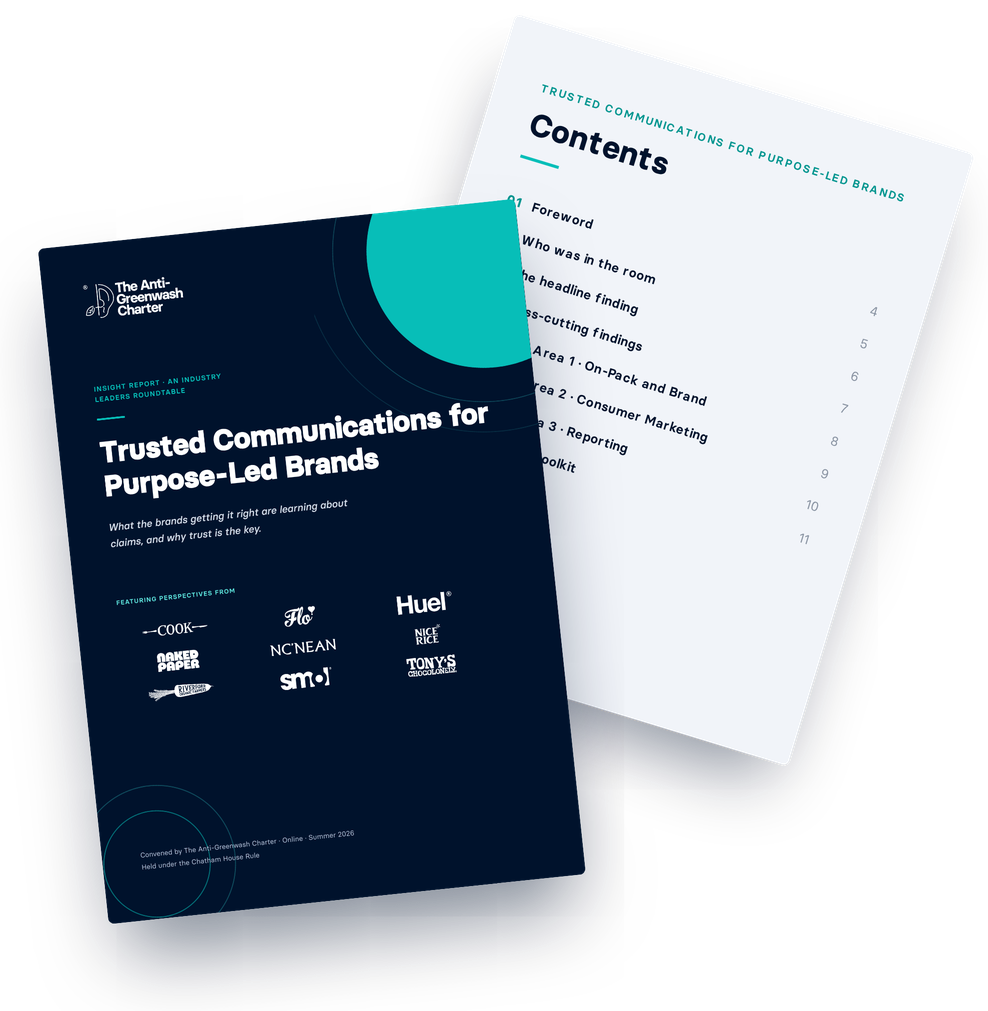
The resulting report, Trusted Communications for Purpose-Led Brands, published in August 2026, provides some answers.
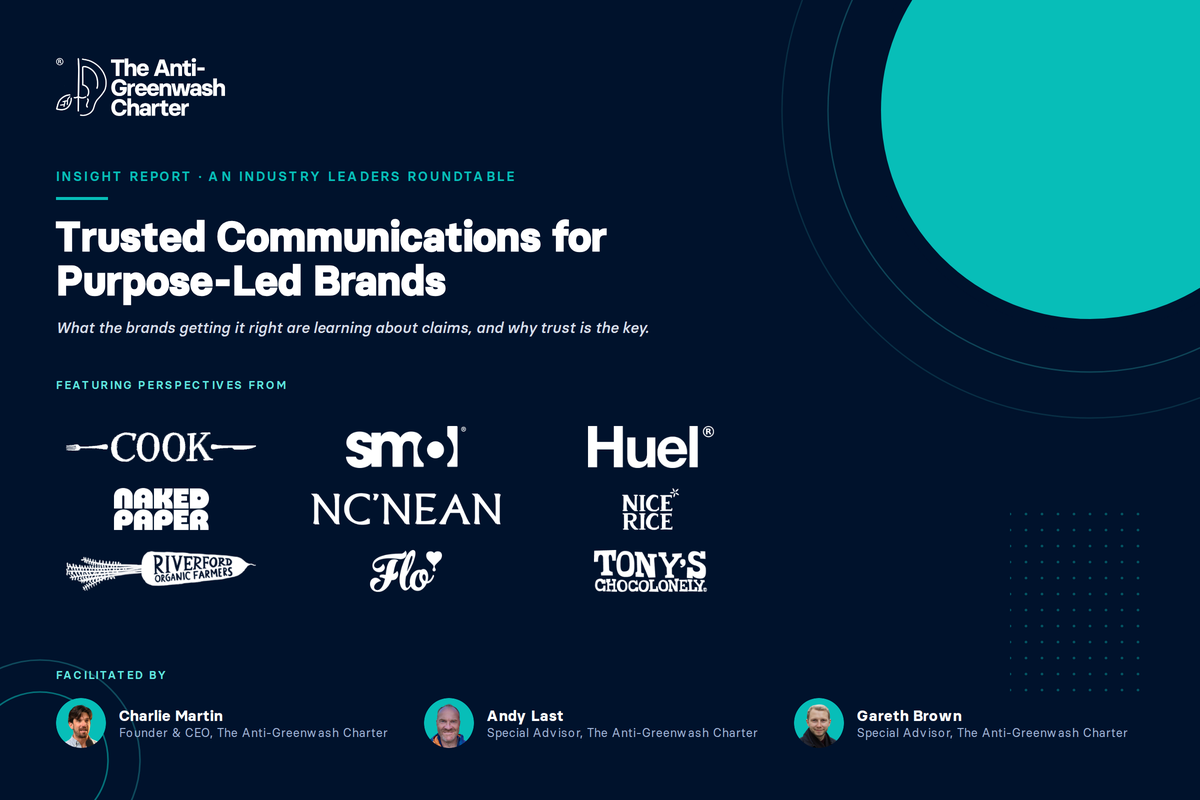
Gareth Brown and Andy Last
Gareth Brown is a marketing director with over fifteen years of experience growing market-leading brands in the UK and globally, including as Global Marketing Communications Director at Duni Group. He facilitated the roundtable and advises both truMRK and the Anti-Greenwash Charter.
Andy Last co-founded salt communications, one of the UK’s first B Corps, scaling it from start-up to a multinational business before its sale to Interpublic Group.
He is the author of Business on a Mission: How to Build a Sustainable Brand and advises the Anti-Greenwash Charter on sustainability leadership and communications.
Sustainability Is a Lever of Trust
The report’s most commercially significant finding concerns the relationship between sustainability communication and brand confidence.
Organisations at the top of their field have recognised something that goes beyond regulatory compliance. A credible sustainability record, communicated with precision and evidence, does not only protect a brand from scrutiny. It builds the kind of trust that drives customer loyalty, retail advocacy, and long-term brand preference.
“Sustainability is a lever of trust,” Andy said. “And that is only as strong as the last piece of communications you’ve made.”
The report identifies five cross-cutting findings. One of the most valuable is that a strong track record of responsible practice protects a brand when challenges arise. An organisation that has consistently communicated with evidence, honesty, and precision can respond to a limited issue, correct it transparently, and preserve customer confidence. That protection is built through cumulative credibility, not through any single claim.
“Trust is built across different parts of the business. If a limited issue arises, a strong record can help us put it right transparently and maintain confidence.”
Precision as Competitive Advantage
The roundtable found that the most effective sustainability communicators lead with precise, product-level claims that are fully substantiated and genuinely differentiating. A specific figure tied to a defined product and boundary can remain accurate under competitive or regulatory scrutiny in a way that sweeping claims cannot.
This is a competitive advantage, not a constraint. While less rigorous competitors make broad claims that do not withstand scrutiny, a brand with a fully evidenced, specific claim occupies a position that is genuinely defensible.
“Many competitors cannot make this specific claim. But we can state it with confidence because it is true and evidence-based.”
The report finds that the most advanced organisations are treating the incoming regulatory environment, including the EU’s Empowering Consumers Directive, which will come into force on 27 September 2026, as an accelerant rather than a problem. Brands with their evidence base, claims policy, and governance already in place are ahead of the curve.
The Discipline That Protects Every Claim a Brand Makes
The roundtable’s deepest finding connects sustainability communication to the health of the whole brand.
A brand caught out on a sustainability claim does not only lose that claim. It teaches its customers to doubt the next one, about nutrition, about quality, about anything. Credibility does not compartmentalise. This is why the discipline the report describes matters beyond sustainability: precision, substantiation, honesty about limitations, and ownership of every channel are the same disciplines that protect everything else a brand says.
Sustainability is the subject. Trust is the asset.
The report identifies the internal handoff from sustainability teams to marketing as the point of greatest vulnerability. When qualifications and context are stripped in the edit, accuracy is compromised before the claim reaches the customer. The practical solution the group converged on is a living claims policy, a single record of approved claims with their scope and substantiation, reviewed by compliance before marketing refines the language.
One participant described opening up about known gaps in its own supply chain, alongside the remediation underway. Rather than damaging credibility, it built it.
“Transparency builds understanding first, and it’s that understanding that makes trust meaningful, rather than blind trust.”
What the Charter and truMRK Make Possible
The roundtable’s magic wand answers were unanimous.
Gareth’s: a market in which third-party verification of sustainability claims becomes the expected standard. When customers begin to favour independently verified claims over unverified ones, the commercial advantage flows to brands that have invested in getting it right.
“If we reach the tipping point where customers turn away from brands that aren’t verified, suddenly a lot of organisations who are maybe trying to wing it slightly will start taking sustainable communications more seriously.”
Andy’s: an independent mark, simple and credible, that sits on a piece of communication and tells the audience that what is being claimed about sustainability has been independently checked as true.
“Simpler, better communication about an area that increasingly matters to all consumers. The end of lawyer words on pack.”
The Anti-Greenwash Charter and truMRK are built precisely for this moment. The Charter certifies organisations whose Green Claims Policy has been independently reviewed, providing visible evidence of their commitment to responsible communication. truMRK goes further, reviewing individual sustainability claims before publication and issuing a mark that signals independent verification to every audience that encounters the communication.
Together they offer what the roundtable identified as the missing piece: not just the discipline to communicate responsibly, but the independent evidence that the discipline is in place.
The brands in the room are already investing in this. The question is who joins them next.
Sponsored by...
truMRK: Marketing and Communications You Can Trust
👉 Learn how truMRK helps organisations strengthen the credibility of their marketing and communications.
Want to be a guest on our show?
Contact Us.
The Responsible Edge Podcast
Queensgate House
48 Queen Street
Exeter
Devon
EX4 3SR
Join 2,500+ Leaders.
Exploring how to build trust, lead responsibly, and grow with integrity. Get the latest episodes and exclusive insights direct to your inbox.
© 2026. The Responsible Edge Podcast. All rights reserved. The Responsible Edge Podcast® is a registered trademark.
Sponsored by truMRK
© 2026. The Responsible Edge Podcast