
Listen to the full podcast episode on YouTube, Spotify, and Apple Podcasts.
The Article and Who Wrote It
A May 2026 article in Entrepreneur, written by Paul M. Wilson, CEO of online reputation management firm NetReputation, argues that radical transparency is the new competitive advantage. The article contends that openly sharing information across an organisation, including bad news, builds deeper trust, faster decision-making, and stronger customer loyalty than confidentiality can.
The premise is appealing. The article contains no data to support it.
Andrew Horsfall noticed immediately.
“I came to the article and read it a couple of times and I just wasn’t sold on radical transparency. Those two words together feel a bit shock and awe. It’s a bit of a stretch.”
A Lawyer Who Is Deprogramming Himself
Andrew Horsfall has a background that makes him an unusual guide to the transparency debate. He spent a decade as a practising attorney and later eleven years as Assistant Dean of International Programs at Syracuse University College of Law. He has just completed an MSc in Global Health, Food Security, Sustainability and Biodiversity at Royal Holloway.
Those two formations sit in productive tension with each other.
“In law, confidentiality can be currency. Disclosure can sometimes lead to liability. So you want to make sure you’re not creating more problems than using some discretion when you’re communicating.”
He quotes a meme he has carried for years. “Dance like there’s no tomorrow. Email like it may one day be read aloud at a deposition.”
That instinct, shaped by a legal career, is now being actively revised.
“I’m deprogramming my thinking about what it means to be a gatekeeper of information. In the context of sustainability communications, I’m absolutely now on the transparency side of the spectrum. I can see an evolution occurring in real time.”
What the Article Gets Wrong
The Entrepreneur article uses a company acquisition as its central example of radical transparency in action. Andrew finds it poorly chosen.
“There are a lot of things that happen around a business acquisition where you necessarily wouldn’t want to be so forthcoming. It was a weird example at the end of a clunky article with an overpromising headline.”
His deeper objection concerns the article’s framing of transparency as an all-or-nothing proposition. Complete, warts-and-all disclosure across every facet of a business is, in his view, wholly unrealistic for most organisations. Legal, commercial, and regulatory constraints make it so.
What the episode arrives at is a more honest formulation: selective radical transparency. Identifying the areas within an organisation where full and genuine disclosure is both possible and valuable, rather than applying the label universally.
“It’s an oxymoron,” Charlie Martin acknowledges. “But it’s also more realistic.”
What Actually Drives Organisations to Disclose
The episode’s most grounded exchange concerns what is actually happening in practice.
From the conversations Charlie has as founder of the Anti-Greenwash Charter and truMRK, the driver for proactive disclosure is, at present, primarily risk-based. Legal risk. Financial risk. Reputational risk. “It’s much less about trust-building at the moment and far more about: we are concerned about the risk associated with getting this stuff wrong.”
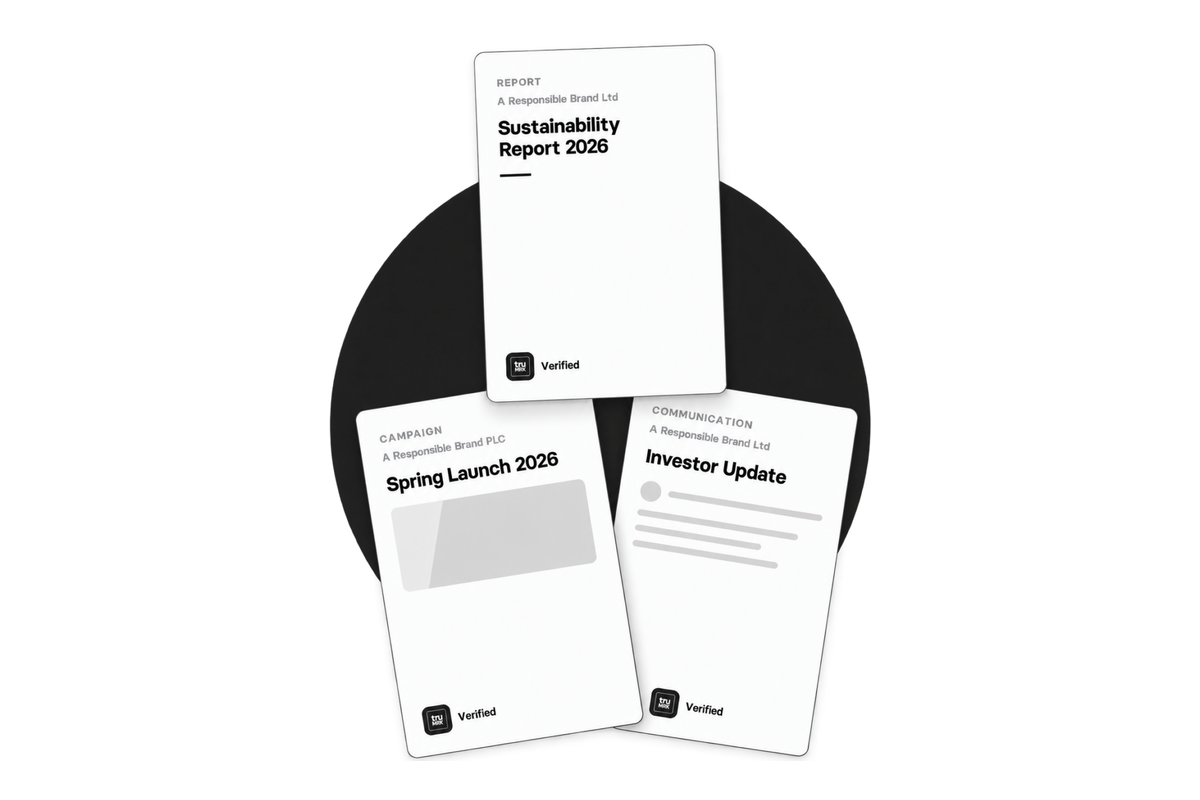
The mechanism he describes is specific. Organisations engage in proactive disclosure so that, when a challenge arises, they can point to an established record of due diligence. The Anti-Greenwash Charter certification and truMRK’s independent verification both serve this purpose: not just as trust signals, but as demonstrable evidence that the organisation has done the work.
“We haven’t yet got to the stage where organisations that implement proactive disclosure are demonstrably winning the trust game. But that’s where this is heading.”
Andrew sees the same dynamic through his environmental governance lens. “Compliance is the floor. But what we’re hoping is that going beyond that generates goodwill and those trust outcomes.”
The Missing Research
Both Andrew and Charlie identify the same gap: no one has yet produced the data showing a clear correlation between proactive transparency and measurable trust outcomes in commercial organisations.
The Entrepreneur article asserts the connection confidently. The evidence is not there.
“I’ve seen loads of research on the value of trust,” Charlie says. “What I haven’t seen is anything that shows the correlation between radical transparency and trust outcomes. I’ve only ever seen it asserted.”
Andrew’s response: “That’s one for the research arm.”
The episode leaves the question open deliberately. The hypothesis is sound. The proof is still being built.
Nature at the Table
Andrew’s magic wand answer lands somewhere unexpected.
He would give nature legal personhood. Not metaphorically, but structurally. The same legal imagination that created corporate personhood, giving corporations the ability to enter contracts, borrow money, and have legal standing, applied instead to rivers, forests, and ecosystems.
“If we had the legal imagination to do that, which seems to do so well in this capitalistic system, I would love to see us exercise that imagination in the arena of nature. Give ecosystems legally recognisable interests, and empower people to act on behalf of those interests as we do with corporations.”
He notes this is already beginning. The town of Lewes in East Sussex has recognised the rights of trees. A river has been granted rights in the UK.
“If nature had a seat at the table with rights-bearing interests, how might it change the commercial system?”
The Entrepreneur article does not go anywhere near this question. The episode, characteristically, ends somewhere the article did not know it was heading.
Sponsored by...
truMRK: Marketing and Communications You Can Trust
👉 Learn how truMRK helps organisations strengthen the credibility of their marketing and communications.
Want to be a guest on our show?
Contact Us.
The Responsible Edge Podcast
Queensgate House
48 Queen Street
Exeter
Devon
EX4 3SR
Join 2,500+ Leaders.
Exploring how to build trust, lead responsibly, and grow with integrity. Get the latest episodes and exclusive insights direct to your inbox.
© 2026. The Responsible Edge Podcast. All rights reserved. The Responsible Edge Podcast® is a registered trademark.
Sponsored by truMRK
© 2026. The Responsible Edge Podcast