
Listen to the full podcast episode on YouTube, Spotify, and Apple Podcasts.
Legal Promises, Operational Failure
Britain makes commitments to the people it sends to serve. A 2026 report, After Service: The Hidden Costs of Britain’s Military on its Veterans, documents what happens next. The legal promises exist. At the moment people leave the forces, they break down.
Ten percent of service leavers struggle to find employment in year one. A further fifteen percent need what Jim Holland calls “a hand up, not a hand out” in the first two years.
The support architecture that exists on paper does not reliably materialise in practice. The transition point is where the system fails. Jim knows this because he lived it.

Barnsley, a Town Centre Pub, and Three Missing Things
Jim Holland served thirteen years as a Weapons Engineering Artificer in the Royal Navy. He left at thirty. He went back to Barnsley, where male unemployment was high and the economy had not moved much since the late eighties. He bought a town centre pub.
“Potentially not the best decision I ever made as a thirty-year-old single man,” he said. “It was certainly a lesson in economics.”
What he did not understand at the time was the nature of what he had lost. “I hadn’t realised that I was missing three things: my forces family, my purpose and my identity.”
He eventually got a hand up into Vodafone from a manager named Michael O’Connor, a moment he describes as a genuine inflection point. A corporate career followed in telecoms, aviation, and finance. He lost his position at Manchester Airport Group during the pandemic. He used the time to build something that addressed the problem he had lived through.
The Mechanism: More Trees, More Veterans
Carma, short for Carbon Karma, pairs corporate climate action with veteran employment. The logic was handed to Jim by Andy Steele, a former Royal Navy colleague who had built the Green Task Force in Hull: an organisation providing employment pathways to veterans and service leavers through nature-based work.
The mechanism is clean. “The more trees we get to plant, the more veterans and service leavers we can help back into employment.”
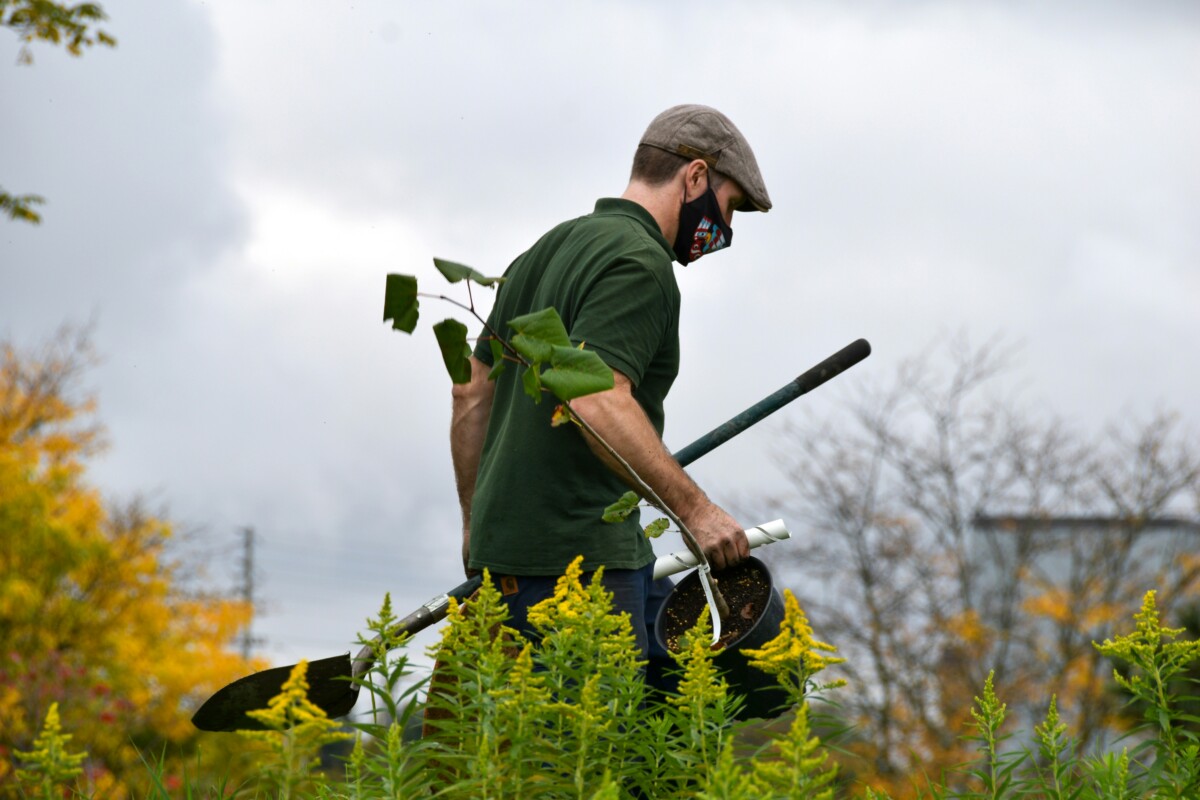
Tree planting creates jobs. Veterans do the planting. They receive vocational qualifications in horticulture as a minimum. Those with PTSD receive nature-based therapy. Employers are then engaged to bring them into wider employment.
For the corporate client, the value proposition stacks three ways.
“When you plant a tree, three wonderful things happen. First of all, you create jobs. Secondly, you get net biodiversity gain. And finally, a tree breathes in CO₂ and breathes out oxygen.”
The model currently serves clients including Leonardo, Leidos, and GoCardless.
Why Hiring Managers Misread Veterans
The report’s findings about broken support systems extend into the employment market. Jim’s reading of why veterans are underemployed is precise. It is not about trauma, though the media noise around that is significant. It is about misreading.
Veterans leaving service are highly adaptable, resilient, and structured. Hiring managers, Jim suggests, sometimes perceive that structure as a threat. The concern is not that a veteran cannot do the job. It is that they might do it too well.
“When you perceive someone as a threat, the loyalty that you will command off that person is almost immediate.”
Veterans, he argues, want to be led. They want structure and purpose. An organisation that provides those things will get extraordinary returns.
Climate Action as a Price We Have Never Paid
Jim’s magic wand is a reframing. He would remove the word cost from how businesses think about climate action and social value.
“People see climate action and social value as a cost in business. On a personal level, I see it as a price that we’ve never had to pay before.”
The argument that follows is commercial rather than moral. Legislation is coming. Governments do not have the funds to solve the problem themselves. They will eventually require businesses to act. The companies moving now are ahead of that curve.
“Companies that do it now are stealing the march. They’re being pioneers. They’re being thought leaders in this space, not reacting to legislation.”
The businesses that wait will face compliance costs, reputational lag, and a workforce and customer base that has already moved on.
What the System Has Not Solved, the Market Is Being Asked To
The deeper tension in the episode is structural. Britain’s veteran support system carries legal obligations it does not consistently meet. Carma is a market-based attempt to address what that system leaves behind. It works by attaching veteran employment outcomes to corporate ESG spending, making the intervention fundable through budgets that already exist.
Whether a commercial model can durably substitute for a state obligation is a question the episode does not resolve. Jim’s answer is pragmatic: the state is not doing it, the money for it sits in corporate sustainability budgets, and the outcomes are real.
“Never before has it been so important to bake into your business practices doing good, helping people, and helping the environment. People make the distinction of the human race and nature. We’re all one.”
The model is growing. The gap it is filling is not.
Sponsored by...
truMRK: Marketing and Communications You Can Trust
👉 Learn how truMRK helps organisations strengthen the credibility of their marketing and communications.
Want to be a guest on our show?
Contact Us.
The Responsible Edge Podcast
Queensgate House
48 Queen Street
Exeter
Devon
EX4 3SR
Join 2,500+ Subscribers.
New episodes exploring responsible marketing, reporting and communications, straight to your inbox.
© 2026. The Responsible Edge Podcast. All rights reserved. The Responsible Edge Podcast® is a registered trademark.
Sponsored by truMRK
© 2026. The Responsible Edge Podcast